The pace of human discovery within a scientific paradigm is inversely and exponentially proportional to the body of discovery already accomplished inside that paradigm.
Science under such a burden cannot suffer disruption for centuries to come—mandating multi-agency bureaucratic approval and peer-review for every new effort and at every new doorstep of research.
Cognitive Load Theory suggests that a person engaged in the act of lying must process more streams of logic than a person relating a simple fact or observation. Due to our limited capacity for processing information, lying requires more time as the liar must assemble a more complicated calculus of contention. The liar needs to reconcile multiple streams of consistency: the fabricated story itself, the truth they are seeking to deflect, the perceptions and responses of the audience, and the consistency of the liar’s tale with the their previous statements or established prior art on the topic.
Lying involves continuous ‘strategic monitoring,’ where the liar constantly checks their responses against past statements to maintain consistency. This continuous monitoring increases cognitive load and slows down response times. Finally, lying can be viewed as a kind of multi-tasking: managing the lie and managing the interaction. This results in an increasing game of rhetorical deflection along with the necessity of placing the liar on a pedestal of virtue or non-assailability.
This understanding is supported by several studies and reviews, which highlight the cognitive demands and complexities involved in deception. Neuroimaging studies have shown that areas of the brain associated with cognitive control are more active when lying compared to telling the truth, indicating the higher cognitive load involved in deception.1 Such studies provide comprehensive insights into the cognitive demands of lying and the methods used to detect deception by increasing cognitive load.
Diminishing Systemic Returns Under Large Audience Demand
Fast Radio Burst Congery 121101 – dual differential dispersion arrivals reflecting Schwarzschild but not Shapiro effect.
This principle is not simply a principle of human psychology; rather, it applies to large systems and organizations as well. It is a fundamental law within computation and complex systems (this is my professional domain) that system load functions in inverse proportion (∝-1) with its performance.
Of course, we all understand the impact bureaucracy has on the response times of medical and governmental organizations. This is a given. However, an expanded application of this theory I have developed posits that the computational load on a universe increases as the independent observer load within that universe also increases. In our universe, the result is that the Planck interval of time (tp = 5.39×10−44 seconds at present) dilates as outside observers are introduced into its deterministic fabric. In other words, both the deterministic-monist and the observer-dualist are correct, with some entities being trapped in this monist fabric and others merely visiting and observing-dilating. As a consequence of this Planck interval dilation, Planck-time begins to slow over time, resulting in several physical phenomena we document in our observable universe.
This theoretical framework suggests that as more observers (or observational events) are introduced, the universe’s computational demands increase inside its finite Bekenstein bound, or the maximum amount of information that can be stored within a given information-derived volume of spacetime. When an observer interacts with or measures the system, they are trying to determine its exact state among many possible states and past states. This process requires computation and information processing on the part of the Universe being observed. The act of observation or measurement converts potential information (high Shannon entropy, many possible states) into actual information (the specific state of the system), which involves computational effort. This leads to a necessary dilation of fundamental time intervals to compensate for the increased computational demand.
In other words, the observer does not witness the past evolving into the present. Instead he witnesses an extant factor which the universe offers up in response to his query. However the universe must first check to ensure that what it offers up, is in accord with what it has offered up in the past for this same frame of reference and query subject posed by the observer. In other words, as observers and observational events increase, the Universe must ‘tell its story’ to a progressively larger audience.2 As that audience gazes further and further into the past, the story is forced to further and further simplify, leading to an inevitable singularity in its tale.
Under this construct, the interference that should not exist in the context of a single photon transiting the double slit experiment, yet still does nonetheless, is a case of the universe inadvertently oversharing. By making the lie too perfect, it betrays its own illusion.3 This is akin to a suspect in a murder possessing the perfect alibi, until he inadvertently mentions the weapon used in the crime, when he should not have had any knowledge of it if he was innocent. The universe shared too much. Such experimental observation constitutes a rare Truman Show moment.
Sentience is that which imposes an observer load (red shift) upon the fabric of the universe. No matter its perfection in knowledge or algorithm, an Artificial Sentient Intelligence that fails to impart an observer load remains merely a computational and deterministic subset of that fabric. It is merely an image in a clever mirror and subset of our intent.
I place a novel computational load on the fabric of the universe; therefore, I am.
This principle could potentially explain cosmological phenomena such as the galactic redshift or path-dependent Fast Radio Burst dispersion (see image above right, extracted from our FRB study), wherein the light from distant sources begins to exhibit exotic effects as it traverses spacetime itself. Perhaps it is not space influencing this per se, but rather the audience of observers which places load on computational time-flow inside the universe—an expansion of the cosmological observer effect in quantum theory.
Diminishing Narrative Returns
I postulate that such duality is analogous to syndicates and bureaucracies as well. It is not simply the cognitive load of the lie itself, nor merely its consistency with past lies, but also the necessity to accommodate all this to the audience of observers.
Ethical Skeptic’s Principle of Diminishing Scientific Returns, or ‘Narrative Redshift,’ combines elements of both Cognitive Load Theory and Diminishing Systemic Returns Under Large Audience Demand into a single bureaucratic phenomenon. As the complexity and volume of a narrative increase, whether in scientific discovery, bureaucratic systems, or deceptive practices, the rate of meaningful or coherent additions to the narrative diminishes. This is due not only to the poor fit of new discoveries but also to the increasing cognitive load required to maintain consistency, address growing scrutiny, and manage the demands of a larger audience.
Ethical Skeptic’s Principle of Diminishing Scientific Returns (or ‘Narrative Redshift’)
The pace of human discovery within a scientific paradigm is inversely and exponentially proportional to the body of discovery already accomplished inside that paradigm.
A Narrative must answer questions progressively more slowly over time, resulting from efforts to ensure that discovery both conforms to The Narrative Line and is consistent with past established elements of narrative.
As the tangled web begins to become obvious to outsiders, a shroud of rhetoric and virtue must be established to protect The Narrative Line.
Exhibit A – The Narrative Redshift or Principle of Diminishing Scientific Returns – as the lies increase, in an effort to protect The Narrative, the pace of scientific discovery decreases exponentially as a result—while the pace of rhetoric and virtue-shielding must increase non-linearly as an outside audience begins to perceive the oncoming shortfall in ethics and value. This is a form of syndicate hand-waving.
A Critical Example in Official Pseudoscience
Penguin carving found at Göbekli Tepe. Nothing to see here folks, let’s seal it up! (Note: this is not an Auk, Auks have hinged midset wings—not forward set fin-wing structures, a full birdlike tail, diamond-spaded beak, and longer duck-like webbed feet. None of these features exist in the chiseling)
A decade ago, I attended and presented at a conference in Houston, where I had the opportunity to converse after hours with one of the other conference presenters, who happened to be an archaeologist. Since this is one area of personal fascination, I raised the issue of Göbekli Tepe with her. She looked off to the side and offered a slight, disconcerted expression.
“It’s being shut down and reconstructed for tourism now. The latest findings are, let us say, existentially upsetting to various groups, and I will leave it at that.”
The discovery of a penguin carving at the Göbekli Tepe World Heritage Site (referenced in the finding registry at right) should have propelled the site into the spotlight of funding and research activity. Where are the excited archaeologists? At the very least, this finding should have elevated Göbekli Tepe’s status as a potential hub of pre-pottery Neolithic global intellectual exchange. Yet, we somehow changed our mind mid-excavation and now choose to principally ignore it, despite both its paradigm shattering history and ongoing potential.
To wit, in 2017 the International Council on Monuments and Sites raised objection to the principal cessation of archaeological excavation at Göbekli Tepe in their ‘Interim Report and Technical Evaluation’ to UNESCO and the Turkish Government.4
The ICOMOS panel considers that there is an imbalance between the scientific research requirements and prospects as indicated in the nomination dossier, and the proposed management plan. The ICOMOS Panel would appreciate if the State Party could provide reassurances regarding the continuing medium-and long-term funding of fundamental, independent, scientifically motivated and managed research programmes.
~ ICOMOS Evaluation Unit letter to UNESCO, 22 Dec 2017
These are no mere tales, as evidenced by concerns on the part of discipline scientists and the re-adaptation of the site for ‘prolonged’ inactivity—it’s removal from the archaeological landscape and burial inside the lost annals of bureaucratic history. An erstwhile crate containing the Ark of the Covenant, from cinematic Indian Jones lore.
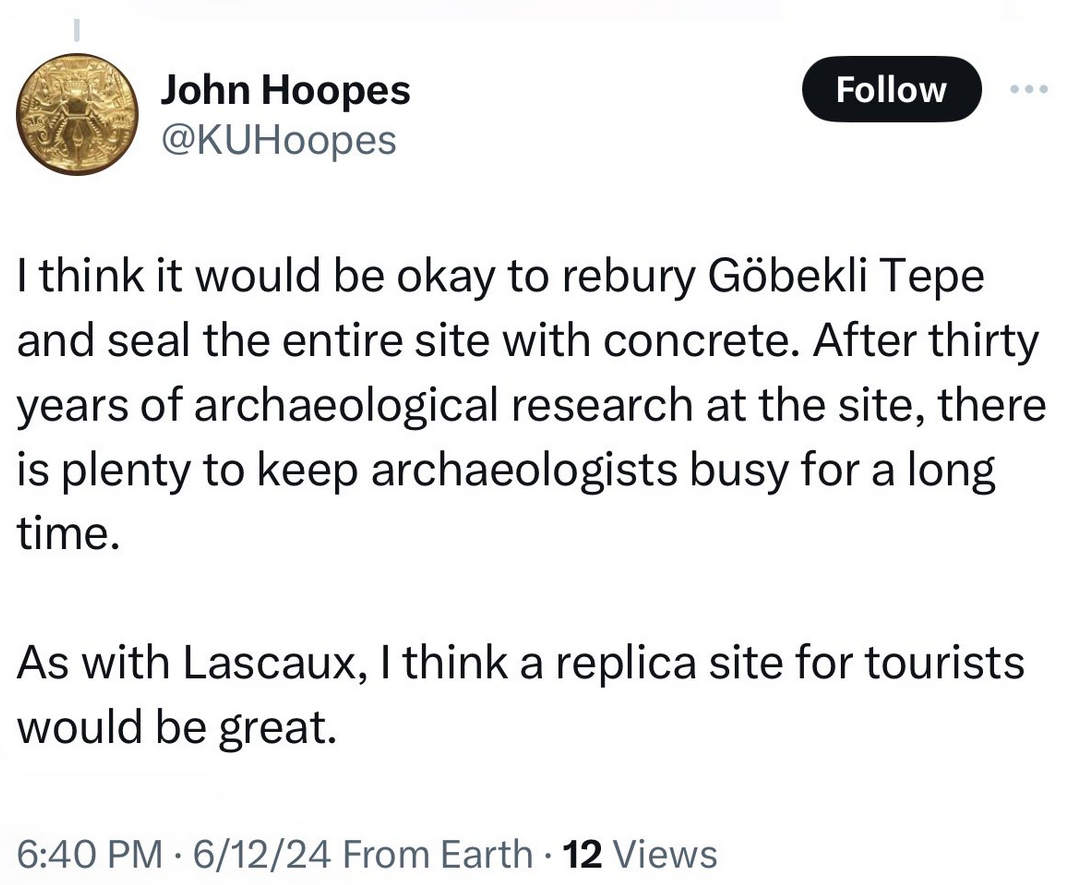
Thus, archaeological hand-waving becomes a necessity, with no better example than The Narrative Line expressed by John Hoopes, Harvard PhD in Anthropology, who stated, “I think it would be okay to rebury Göbekli Tepe and seal the entire site with concrete. After thirty years of archaeological research at the site, there is plenty to keep archaeologists busy for a long time.”5 I did not realize that the sole purpose of mankind’s heritage was to entertain and enrich archaeologists. I will have to make note of this highly-educated doctrine of philosophy.
The fact that this site is neither the property nor the propriety of archaeology/anthropology reveals this statement for what it really is: oppressive virtue-rhetoric employed to protect The Narrative Line (the green curve asymptotic to the red line in Exhibit A above).
Another key example of the incompetent virtue, rhetorical, and ‘why would’ hypothetical deflection to bolster The Narrative Line can be found in this piece of accusatory and unprofessional propaganda by photographer Rupert Soskin. If you insist upon calling persons who attempt to hold archaeology accountable “die-hard conspiracy theorists,” then I am going to insist upon calling you a ‘condescending fraud.’ The fact that this pejorative is your first-recourse and strongest argument, casts nothing but shame on you and your claim to professional authority.
The doorway to fraud typically opens when an accountant begins to subconsciously believe that the money they administer is their property. This also applies to science, government, and religion.
No qualification grants you the right to demand my ignorance.
A fundamental requisite of a self-appointed god is to conceal anything that predates your authority.
Example of How a Close-Hold Embargo Works
Except in this instance, the archaeological site is being interred beneath a more robust barrier than simply Hoopes’ metaphorical concrete; rather, more tantalizingly, “elements and forms of past landscapes inside a motif of use, option, and existential values” according to an example dissertation justifying such actions.6 This is code-speak on the part of the wayward discipline and the presiding Şanlıurfa Council for Conservation of Cultural Properties for ‘planting regionally-endangered olive trees,’ trees that cannot be cut down by law in Turkey,7 in an environment which is not natural forest, but semi-arid Mediterranean plateau. In other words, they are not innocently ‘planting trees’, but rather creating a barrier of perpetually fragile and re-establishing woodlands.
ChatGPT-4o: As olive trees can live for centuries or even millennia, their root systems become extensive and complex over time. In dry, elevated, or arid conditions, olive trees develop deeper taproots to reach water. Their roots can penetrate to depths of 20 feet (6 meters) or more in search of moisture. Olive tree roots can spread horizontally two to three times the width of the canopy. In rocky or shallow soils, their roots will spread widely to anchor the tree. Olive tree roots pose significantly more complication at an archaeological site compared to the average tree, primarily due to their unique growth characteristics and the long lifespans of olive trees. While their downward growth is typically moderate compared to their horizontal spread, olive tree roots are strong and persistent. They can penetrate through small cracks in rock or masonry, potentially damaging, defacing, or displacing buried structures, pottery, or other archaeological materials. Olive trees thrive in rocky, poor soils where their roots often entwine around each other or penetrate through hard substrates. This adaptability means they can disturb even compacted layers of soil or buried features more aggressively than many other tree species. Olive trees can live for hundreds, sometimes thousands, of years. Over such long periods, their roots may repeatedly alter the stratigraphy of a site, blending or displacing archaeological layers and making it more difficult to interpret the timeline of human activity. The organic material from olive tree roots, including decayed remnants, can introduce chemical changes in the soil, potentially affecting the preservation of artifacts and especially organic dating residues. Finally, ancient or endangered-species olive trees are sometimes culturally or historically significant themselves, complicating decisions about their removal or disturbance.
For example, in the ‘conspiracy theory’ polemic by Rupert Soskin linked above, he asserts that the planted olive trees were used to improve the property value of the land on behalf of the owners. Ergo, these trees can never be removed because of the entailed damage to real property value. Without realizing it, Rupert falsified his own claim in an effort to justify it (autoauhfeben appeal). However, the obfuscation scheme remains diabolically clever nonetheless.
Incompetence is neither a conspiracy nor a theory.
This is part of the protection and management of Göbekli Tepe, carried out under a UNESCO World Heritage Centre management plan that was finalized in 2017, under funding by the World Economic Forum.8 All this enacted, fully cognizant that a nascent and fragile ‘re-establishing ancient landscape’ will not be allowed disruption for centuries to come—mandating multi-agency bureaucratic approval for every new initiative and at every new step of research.
Pillar 43 at Göbekli Tepe – “It’s an ancient temple.” (Sighs of Pollyannish recognition ensue…) Therefore, our enlightened syndicate ‘science’ can ignore the fact that the stone is attempting to communicate an event from 14,800 BCE, as mere religious babble – relegated to the bin of ‘ignore this.’
A mere 5% of Göbekli Tepe has been unearthed over the decades. In contrast, 66% of Pompeii and Herculaneum have been excavated and fully documented to the public at large during that same time.9 We’ve invested copious amounts of time and advanced technology to recover wooden artifacts from Herculaneum, simply to marvel at their dazzling decorative inlays and designs.
The only distinction resides in what is being unearthed and the disruptive potential with regard to The Narrative Line.
I find it ironic that archaeology will gladly process voiceless finds in an agnostic assembly line of typology, but artifacts with actual content and expression on them, messages to future generations – “we’ll get to that later.” …It is so transparently dishonest.
Once an archaeological site has established that its purpose was to communicate messages to future generations, as is unequivocally the case with Göbekli Tepe, and does not reside in the context of mere mundane human habitation, the ethical responsibility of such a site passes from the hands of one sect of science into the domain of humanity’s intellectual property. As such, its excavation and transparency become the duty of those who administer the site on behalf of humanity. Claiming a need for ‘better technology’ simply to unearth and interpret these artifacts is disingenuous.
The only hesitation I have on this may stem from concerns that these artifacts will conveniently disappear, as has so often occurred throughout the history of this form of liberal arts pseudoscience called archaeology. In other words, we await spiritual maturity, not technological advancement.
As a result, the “existentially upsetting” artifacts which lay buried under the ground at Göbekli Tepe, will be forever and ironically entombed by our very fanatical veneration of them. The astute ethical skeptic should note that this is how our most prominent religions ply their craft as well. What better way to conceal something, than make it an object of obsession.
Fanatical obsession is after all, the most sincere form of disbelief or dishonor.
Fully 80% of the Göbekli Tepe site is now rendered inaccessible to students, independent researchers, or scientific focus teams for centuries to come. Any objections are met with the de rigueur “You don’t understand how archaeologists work.” As an experienced professional science and technology ethicist I fully comprehend what I am witnessing.
Exhibit B – Göbekli Tepe 100% Interred Under Tourism Rhetoric and Trees – decades ago at the beginning of its research, versus today being completely shut down by ironic veneration—offering critical time to figure out how to reconcile the findings therein, with the lies of The Narrative crafted for our past bedazzlement.
There exists a curious poetry to the fact that someone deliberately buried the complex and destroyed all the human-shaped depictions in antiquity—and yet are now deliberately burying and concealing its messages once again.10 It is clear that an erasure is going on here, and that this erasure constitutes vital archaeological evidence. Evidence which we will Nelsonianly ignore, ironically in the very name of science itself.
Exhibit C – Göbekli Tepe Excavation Future versus Recently Planted Olive Trees – critical excavation sites entombed below trees that can live to be 6,000 years old and are illegal to cut down in Turkey (Olive Cultivation Law No. 3573).1112
Finally, perhaps, and this is a stretch, we are not allowed to further investigate the complex because it is not “under the domain of humanity’s intellectual property” after all? We are allowed to investigate our heritage, but not others’ who were “still on the Earth in those days” and built 7.5 ft tall, while seated, portrait statues of themselves.13 Nah …who would believe such a ridiculous notion.
Regardless, this is how darkness applies its craft, fully conscious of appearances and aware of its audience, shrouded in virtue—fully cognizant as well that the pace of scientific discovery is grinding to a time-dilating and redshifted, halt.
Ethical skepticism, involves becoming a student of this particular form of tradecraft inside ponerology.
LLL
The Ethical Skeptic, “The ‘Narrative Redshift’ or Principle of Diminishing Narrative Returns”; The Ethical Skeptic, WordPress, 13 Jun 2024; Web, https://theethicalskeptic.com/?p=89300
For further reading, you can explore the works of Vrij, A., Granhag, P.A., & Porter, S. (2010) in “Pitfalls and Opportunities in Nonverbal and Verbal Lie Detection” published in Psychological Science in the Public Interest, and Vrij, A., Fisher, R.P., Mann, S., & Leal, S. (2006) in “Detecting Deception by Means of Cognitive Load” published in Trends in Cognitive Sciences.
Mosler, A.; LANDSCAPE ARCHITECTURE ON ARCHAEOLOGICAL SITES: Establishing landscape design principles for archaeological sites by means of examples from West Anatolia, Turkey; https://mediatum.ub.tum.de/doc/601024/601024.pdf
Olive Cultivation Law (No. 3573), enacted in 1939. This law specifically prohibits the cutting down of olive trees in areas where there are at least 25 trees per hectare.
Dietrich, Oliver & Dietrich, Laura & Notroff, Jens. (2019). Anthropomorphic Imagery at Göbekli Tepe. 10.2307/j.ctvvh865z.12.
Olive trees in Bechealeh (Lebanon) – A group of trees believed to be over 6,000 years old, though scientific verification is challenging.
Olive Cultivation Law (No. 3573), enacted in 1939. This law specifically prohibits the cutting down of olive trees in areas where there are at least 25 trees per hectare.
One should note that the Balıklıgöl Statue (aka ‘Urfa Man’), found in the city of Şanlıurfa near Göbekli Tepe and dating to 9,000 BCE, depicted an individual who stood 8 ft 10 in in height, if true to life.
It is an interesting notion, but the acceleration does not provide that long of a time dilation at a local level. Asymptotically approaches zero to our immediate perception.
Andrew
1 year ago
I’m not an expert whatsoever, and I couldn’t agree more with the rest of the article, but the cosmological aspect of the piece reads highly conspiratorial. It gives a suspicious agency to the universe where it purposefully lies to us. This would be fine if it came along with increased explanatory power, but it appears to just re-explain what is known, or contradict relatively strong empirical evidence re: Planck Time. What do you think of this critique?
You are correct Andrew, right now the observation dilation of Planck Time is a construct and not a true hypothesis. However, development of a construct and its maturing into a novel hypothesis is part of the scientific method – especially when the existing constructs have zero probative strength and elegance themselves. In other words, this is a problem with ALL current cosmological notions inside this domain. In other words, when Ockham’s Razor contends “Plurality should not be posited without necessity” – that applies to the situation we are in. We have necessity to propose a novel idea. … thus one… Read more »
Patrick
1 year ago
Reminds me of John Archibald Wheeler’s “it from bit” interpretation of quantum mechanics. According to the theory, we are playing “20 questions” with the universe where each quantum observation is a “question” that the universe “answers” with an experimental result that is consistent with all previous results. The universe doesn’t actually “know” the ultimate object; it just keeps making up answers to maintain a consistent story. We therefore “generate” reality by our act of observing it.
1) It’s not simply academics protecting a historical narrative. The WEF does not care about the decades old dissertations, reputations or pet theories of academics, look how readily they discarded dozens of well-respected scientists during the COVID years. 2) So too the WEF does not care about Turkey, its people nor its government. Look how readily they discarded millions of lives with COVID. The Turkish people are cattle to them. 3) Ultimately the WEF does not care about NATO. Otherwise it would not fund NATOs “enemies” as freely as its allies. It would not take American avionic secrets and sell… Read more »
Well framed and stated, Orb. Yes, there is more I know and suspect, than I am willing to offer in this blog, or even to persons in my life. What I have found in the interviews with media executives interested in this material thus far, is that while they cite the need for “rigorous epistemological soundness” (and of course I wholeheartedly agree – and cite the science must provide this, not one mere man…) – their real interest and passion is invested in the conjecture… they devour and love it… This is the little game we all play as humans.… Read more »
Olga
1 year ago
Are there no scientists mature enough to deal with the “existentially upsetting” implications? I would appreciate an understanding of the actual ground truth of my life and what – perhaps – I need to consider and prepare for – so any links would be greatly appreciated.
Well – For a former pot-smoking art major that was a bit of a slog – but I got through it. So – the proverbial “they” are not acknowledging that the oceans are warming from the bottom – probably due to it being step one in a cascading series of events that ends with some pretty dark, miserable times – for the lucky? Unlucky? The powerful people who escape to their DUMBs? I could head for an appropriate elevation and hope for the best but I suspect I will sit tight and play with the grandkids while reading esoteric blogs… Read more »
“play with the grandkids while reading esoteric blogs that no one around me would appreciate.” :-) LOL!!
The last flood was used to wipe out some pretty nasty vermin/chimera. This well may finish the job. We may well be set free this time.
TES
Flange
1 year ago
I like to cling to the delusion that it isn’t too far away that Erdogan frees Tϋrkiye from the shackles of NATO/EU/WEF and moves to BRICS. That then should only leave Ferret (intentional) Sahenk, the billionaire, as a road block : presumably he can be purchased for shekels. On another note I have been pondering the comparative merits of the Enki ‘spaceship’ disk design versus a truss spar. (How Do Spars Work? | Rigzone)) No topsides, properly ballasted with provisions such that it remains just below/at the water line until deemed safe to be above the waterline. Both with a… Read more »
John Day
1 year ago
I almost didn’t look today. Unassuming title… How do you do this, Sir Skeptic? I have some ruminating meditations on bike rides after dredging the internet for hours, but this is orders of magnitude beyond those musings… I discovered in first grade that I had a talent for fabricating statements in my own favor to adults. It served pretty well (it seemed) until third or fourth grade, when I could tell that it was clearly breaking down, not merely from closer adult observation, but more from reality, itself. I began the path back to truthful rigor, but it still took… Read more »
As the current hypothesis goes, State 2 is a gyroscopic equilibrium, so it would not be locked to the core like the magnetically-bound State 1. There would be some wandering of the rotational pole for a while, all the while, heavy seas (pyramid average was Sea State 8) for a long time. The tectonic activity would send us into a planetary winter for decades – probably why they miss this in the ice cores and just identify it as a ‘volcanic’ period and a ‘geomagnetic excursion’. Cold, dark, wet, stormy, and starving (from lack of agriculture and loss of fauna).… Read more »
Thank you for your thoughtful reply. That seems like a “heck world” at any rate. I searched for a meaning for “EVG”, found 6, and none of them seemed to apply. Well, we (“advanced life”?) ARE here, and it is the nature of many of us, certainly yourself, to seek “meaning”, or “better models”, and there is an inherently-implied value-system of societal/species/life-form benefit being “valued”, so I will press-on that it is not “about” our projections of how we would perceive existence in such a world, fleeting as it might be, but what gifts we could provide to future generations,… Read more »
Functions at both an intellectual and spiritual level. Subtle epistemic truths begin to emerge, while spiritual truth truths trust your terrain well enough to express. Best guess I can give it. (*shrug)…
My avatar is Usir (Osiris). The Lord of Silence. Knowing when to draw inference, and when to remain silent (epoché) – is the key to fortress wisdom. Hence the tag line of ethical skepticism: “𝙚𝙥𝙤𝙘𝙝𝙚́ 𝙫𝙖𝙣𝙜𝙪𝙖𝙧𝙙𝙨 𝙜𝙣𝙤𝙨𝙞𝙨” It takes me almost 5 hours to mow my grounds here with the 50 trees (mostly my plantings) and all the edging around them, and I just put in another hour, so I reflected a bit. The area of North America with the archaeologic evidence of longest continuous human habitation (8800 to 13,000 years) is Spring Lake, near San Marcos, Texas, currently the… Read more »
John, what does it matter if some texas cities survive? How long would any city be habitable without a supply chain??? Ponder that while you mow your lawn. Human population will be 95% reduced because of that dependance on supply chains. Survivors will be random, scattered creatures. I wouldn’t want to be one of them.
That’s not quite the way I was looking at it. I was looking at humans being able to survive in a place for hundreds of years, assuming something like the 95% population reduction you mention. I do ponder that while I mow the acre, and on bike rides, and as I lie awake before and after sleeping. Why do you think “survivors will be random”? You may not really be “working the problem” as one might say. If you are sure you would not want to survive, that is your decision. Have you considered how you might prefer to die… Read more »
John, we’re talking about the earth’s surface peeling off the inner core and moving 10,000 km or more, rapidly. What building is designed to withstand even a fraction of those forces??? None. What roads, bridges, railroads, ports or other infrastructure would remain? It’s not just flood waters that are the challenge here. The ground would be torn apart, hot lava/ash, dust, wind, fires. There’s no predicting where that would be less or more bad. Survivors would be people who are not in buildings or underground structures. They would be outside somewhere, lucky that a mountain didn’t fall on them. Or… Read more »
Yes, I agree with the line of reasoning you take, but this appears to be a thing which has happened before, periodically, so there are ways to prepare, as you have started to consider. We have a rural (Yoakum, pop. 6k) place in the Texas coastal plains, about 70 miles in from the coast, with a large garden and fruit trees, with natural gas wells nearby, and a railroad and HEB (Texas chain) grocery store. I’ve designed and built (a fair amount myself) a house there in the past few years, but it is a poor prep for this situation,… Read more »
It’s interesting that opposition to the regime is being driven to Florida, Texas, Costa Rica and El Salvadore while WEF-owned billionaires are buying up high altitude land. Also interesting the testing the military was doing a few short years ago with conventional charges in the Atlantic off Florida being used to measure the effect on shore. There is little strategic need for larger nukes in nation-state level conflicts, but that isn’t to say there is no practical application (or black budget, or infrastructure) for higher megaton weapons used to simulate natural disasters (ideally a yield>radiation device akin to the inverse… Read more »


Is deja vu a side effect of the universe’s response to observer load?
It is an interesting notion, but the acceleration does not provide that long of a time dilation at a local level. Asymptotically approaches zero to our immediate perception.
I’m not an expert whatsoever, and I couldn’t agree more with the rest of the article, but the cosmological aspect of the piece reads highly conspiratorial. It gives a suspicious agency to the universe where it purposefully lies to us. This would be fine if it came along with increased explanatory power, but it appears to just re-explain what is known, or contradict relatively strong empirical evidence re: Planck Time. What do you think of this critique?
You are correct Andrew, right now the observation dilation of Planck Time is a construct and not a true hypothesis. However, development of a construct and its maturing into a novel hypothesis is part of the scientific method – especially when the existing constructs have zero probative strength and elegance themselves. In other words, this is a problem with ALL current cosmological notions inside this domain. In other words, when Ockham’s Razor contends “Plurality should not be posited without necessity” – that applies to the situation we are in. We have necessity to propose a novel idea. … thus one… Read more »
Reminds me of John Archibald Wheeler’s “it from bit” interpretation of quantum mechanics. According to the theory, we are playing “20 questions” with the universe where each quantum observation is a “question” that the universe “answers” with an experimental result that is consistent with all previous results. The universe doesn’t actually “know” the ultimate object; it just keeps making up answers to maintain a consistent story. We therefore “generate” reality by our act of observing it.
Here is his paper if you want to read more, not too long and relatively light on math:
https://philpapers.org/archive/WHEIPQ.pdf
Patrick,
I love it! Thanks.
TES
1) It’s not simply academics protecting a historical narrative. The WEF does not care about the decades old dissertations, reputations or pet theories of academics, look how readily they discarded dozens of well-respected scientists during the COVID years. 2) So too the WEF does not care about Turkey, its people nor its government. Look how readily they discarded millions of lives with COVID. The Turkish people are cattle to them. 3) Ultimately the WEF does not care about NATO. Otherwise it would not fund NATOs “enemies” as freely as its allies. It would not take American avionic secrets and sell… Read more »
Well framed and stated, Orb. Yes, there is more I know and suspect, than I am willing to offer in this blog, or even to persons in my life. What I have found in the interviews with media executives interested in this material thus far, is that while they cite the need for “rigorous epistemological soundness” (and of course I wholeheartedly agree – and cite the science must provide this, not one mere man…) – their real interest and passion is invested in the conjecture… they devour and love it… This is the little game we all play as humans.… Read more »
Are there no scientists mature enough to deal with the “existentially upsetting” implications? I would appreciate an understanding of the actual ground truth of my life and what – perhaps – I need to consider and prepare for – so any links would be greatly appreciated.
My hypothesis on this (not a claim) – is summarized in three articles, all linked inside this synopsis.
https://theethicalskeptic.com/2024/05/23/master-exothermic-core-mantle-decoupling-dzhanibekov-oscillation-theory/
Thanks for reading, Olga!
TES
Well – For a former pot-smoking art major that was a bit of a slog – but I got through it. So – the proverbial “they” are not acknowledging that the oceans are warming from the bottom – probably due to it being step one in a cascading series of events that ends with some pretty dark, miserable times – for the lucky? Unlucky? The powerful people who escape to their DUMBs? I could head for an appropriate elevation and hope for the best but I suspect I will sit tight and play with the grandkids while reading esoteric blogs… Read more »
Olga,
“play with the grandkids while reading esoteric blogs that no one around me would appreciate.” :-) LOL!!
The last flood was used to wipe out some pretty nasty vermin/chimera. This well may finish the job. We may well be set free this time.
TES
I like to cling to the delusion that it isn’t too far away that Erdogan frees Tϋrkiye from the shackles of NATO/EU/WEF and moves to BRICS. That then should only leave Ferret (intentional) Sahenk, the billionaire, as a road block : presumably he can be purchased for shekels. On another note I have been pondering the comparative merits of the Enki ‘spaceship’ disk design versus a truss spar. (How Do Spars Work? | Rigzone)) No topsides, properly ballasted with provisions such that it remains just below/at the water line until deemed safe to be above the waterline. Both with a… Read more »
I almost didn’t look today. Unassuming title… How do you do this, Sir Skeptic? I have some ruminating meditations on bike rides after dredging the internet for hours, but this is orders of magnitude beyond those musings… I discovered in first grade that I had a talent for fabricating statements in my own favor to adults. It served pretty well (it seemed) until third or fourth grade, when I could tell that it was clearly breaking down, not merely from closer adult observation, but more from reality, itself. I began the path back to truthful rigor, but it still took… Read more »
As the current hypothesis goes, State 2 is a gyroscopic equilibrium, so it would not be locked to the core like the magnetically-bound State 1. There would be some wandering of the rotational pole for a while, all the while, heavy seas (pyramid average was Sea State 8) for a long time. The tectonic activity would send us into a planetary winter for decades – probably why they miss this in the ice cores and just identify it as a ‘volcanic’ period and a ‘geomagnetic excursion’. Cold, dark, wet, stormy, and starving (from lack of agriculture and loss of fauna).… Read more »
Thank you for your thoughtful reply. That seems like a “heck world” at any rate. I searched for a meaning for “EVG”, found 6, and none of them seemed to apply. Well, we (“advanced life”?) ARE here, and it is the nature of many of us, certainly yourself, to seek “meaning”, or “better models”, and there is an inherently-implied value-system of societal/species/life-form benefit being “valued”, so I will press-on that it is not “about” our projections of how we would perceive existence in such a world, fleeting as it might be, but what gifts we could provide to future generations,… Read more »
Ah thanks John!
EVG = epoché vanguards gnosis
Functions at both an intellectual and spiritual level. Subtle epistemic truths begin to emerge, while spiritual truth truths trust your terrain well enough to express. Best guess I can give it. (*shrug)…
My avatar is Usir (Osiris). The Lord of Silence. Knowing when to draw inference, and when to remain silent (epoché) – is the key to fortress wisdom. Hence the tag line of ethical skepticism: “𝙚𝙥𝙤𝙘𝙝𝙚́ 𝙫𝙖𝙣𝙜𝙪𝙖𝙧𝙙𝙨 𝙜𝙣𝙤𝙨𝙞𝙨” It takes me almost 5 hours to mow my grounds here with the 50 trees (mostly my plantings) and all the edging around them, and I just put in another hour, so I reflected a bit. The area of North America with the archaeologic evidence of longest continuous human habitation (8800 to 13,000 years) is Spring Lake, near San Marcos, Texas, currently the… Read more »
John, what does it matter if some texas cities survive? How long would any city be habitable without a supply chain??? Ponder that while you mow your lawn. Human population will be 95% reduced because of that dependance on supply chains. Survivors will be random, scattered creatures. I wouldn’t want to be one of them.
That’s not quite the way I was looking at it. I was looking at humans being able to survive in a place for hundreds of years, assuming something like the 95% population reduction you mention. I do ponder that while I mow the acre, and on bike rides, and as I lie awake before and after sleeping. Why do you think “survivors will be random”? You may not really be “working the problem” as one might say. If you are sure you would not want to survive, that is your decision. Have you considered how you might prefer to die… Read more »
John, we’re talking about the earth’s surface peeling off the inner core and moving 10,000 km or more, rapidly. What building is designed to withstand even a fraction of those forces??? None. What roads, bridges, railroads, ports or other infrastructure would remain? It’s not just flood waters that are the challenge here. The ground would be torn apart, hot lava/ash, dust, wind, fires. There’s no predicting where that would be less or more bad. Survivors would be people who are not in buildings or underground structures. They would be outside somewhere, lucky that a mountain didn’t fall on them. Or… Read more »
Yes, I agree with the line of reasoning you take, but this appears to be a thing which has happened before, periodically, so there are ways to prepare, as you have started to consider. We have a rural (Yoakum, pop. 6k) place in the Texas coastal plains, about 70 miles in from the coast, with a large garden and fruit trees, with natural gas wells nearby, and a railroad and HEB (Texas chain) grocery store. I’ve designed and built (a fair amount myself) a house there in the past few years, but it is a poor prep for this situation,… Read more »
It’s interesting that opposition to the regime is being driven to Florida, Texas, Costa Rica and El Salvadore while WEF-owned billionaires are buying up high altitude land. Also interesting the testing the military was doing a few short years ago with conventional charges in the Atlantic off Florida being used to measure the effect on shore. There is little strategic need for larger nukes in nation-state level conflicts, but that isn’t to say there is no practical application (or black budget, or infrastructure) for higher megaton weapons used to simulate natural disasters (ideally a yield>radiation device akin to the inverse… Read more »