In the days when the Great Year axis aligned above the left wing of the condor, an ominous portent appeared in the sky—one unseen in our lifetimes but foretold through the legends of our forefathers.
Dissatisfied with the explanations offered by archaeology and various internet pundits regarding what is called the ‘Vulture Stone’ (Pillar 43) at Göbekli Tepe, I decided to delve into its meaning for myself.
We often frame the more philosophical missives within The Ethical Skeptic with the apothegm: I did not know, I went and looked; everything else was vanity. For years, I have chosen silence regarding the interpretation and dating of the various relics uncovered at Göbekli Tepe. Without direct participation in the field archaeological work conducted at the site, I have preferred to defer to the expertise of those on the ground rather than speculate in their stead.
However, there comes a point where the cautious, obtuse, and at times arrogant approach often employed by archaeology strains the boundaries of human tolerance. At such a threshold, this becomes not merely a question of professional deference but of humanity’s right to access knowledge about its past—a responsibility that archaeology, as a discipline, has too often allowed to stagnate, adrift and unfulfilled.
Many are those deeply disappointed by the decision of the United Nations Educational, Scientific, and Cultural Organization (UNESCO), in cooperation with the Turkish Government, to effectively halt fundamental, independent, and scientifically motivated excavation efforts at Göbekli Tepe.1 This article (along with others) expands into some examples as to why many people hold such a position of concern.
They share an equal frustration with the lack of genuine curiosity and rigorous investigative effort applied to interpreting the artifacts uncovered at Göbekli Tepe and other archaeological sites. For instance, why was this work the first to recognize that the serpent image carved into the wall of Enclosure AA, or Hypogeum Pit, at Karahan Tepe represents Sheshanāgá, the cosmic shining serpent of ancient lore—an image tied to the Milky Way’s luminous center?2 Furthermore, that this motif also matches the Serpent Mound monument in Peebles, Ohio. How could such a connection escape notice? Surely, this was not that hard to figure out. I have no direct involvement in the field, yet was able to discern the meaning of the image within minutes of seeing it for the first time.
The builders of Göbekli Tepe made their message in the Pillars unmistakably clear, guiding us like children through precisely what they were observing and documenting. Yet, they likely underestimated just how obtuse the children of men would become.
This raises an uncomfortable question: if an outsider can make such connections so readily, what does it say about the level of curiosity and rigor being applied by those entrusted with unearthing and interpreting humanity’s ancient story? The concern ranges past mere intellectual lethargy or bureaucratic stagnation. There are those who sense that fear governs much of the work and conclusions produced within the discipline of archaeology. Fear of being labeled heretical, fear of diverging from the consensus, fear of professional censure and reductive categorization, and perhaps most troubling, fear of unseen powers whose agency and influence remain deliberately obscured.
An Alternative Interpretation of Pillar 43, Its ‘Handbags,’ ‘V’-Scoring, and Iconic ‘H’ Symbols
Dissatisfied with the explanations offered by archaeology and various internet pundits regarding what is called the ‘Vulture Stone’ (Pillar 43) at Göbekli Tepe, this author decided to delve into its meaning for himself. Over the years, we have all had to endure a range of inane and poorly substantiated interpretations about this remarkable artifact. From its alleged role as a map to the underworld or a depiction of regional Levant terrain, to its supposed use as a ‘mythological iconograph for hunter-gatherers,’ to outright lying on the part of archaeological authorities, or even as pseudo-confirmation of Göbekli Tepe’s purported occupation date of around 9600 BCE, we have been inculcated with it all—the narrative, the ridiculous, and the sublime.
My anchor point for the primarily deductive analysis that follows rests on three fixed reference elements. First, I conjecture that the vulture depicted in the iconography is an Old World species, most closely resembling the Indian vulture. I further propose that this distinctive figure corresponds to the constellation Cygnus (also known as “The Swan”). Accordingly, I use the term condor rather than vulture or swan—not only because the carving bears a closer resemblance to the California condor, but also because both the vulture and swan are distinctly different from what is portrayed on Pillar 43—even though condors, 17 millennia later, are confined to the Americas.
Second, I speculate that the round circle carved into the stone, the centerpiece of the image, is not the sun but instead represents the North Celestial Pole (Earth’s projected rotational axis) as it appeared at some point in the distant past—based upon our knowledge of the Precession of the Equinoxes. Finally, I presume that the stone’s artist was both skilled in their knowledge of the night sky over their home and bore a desire to communicate an important message to those generations who followed.
Armed with these three fixed points, I was able to construct a hypothesis—one not yet proven, of course, and approached it with the cautionary realization that linear confirmation bias is a persistent danger in such endeavors. With these considerations in mind, the work commenced.
Pillar 30 – Sunrise sighting stone
In Exhibit A below, the reader can observe how the nine iconographs carved into Pillar 43 correspond strikingly well to the nine asterisms I have identified from the sky field map shown below right (produced using Starry Night Pro 8.1.0). The carvings on the stone align precisely with the Sanliurfa night sky as it would have appeared around 14,800 BCE. Four birds, including the Condor, two snakes, a scorpion, a dog, and what may be a headless frog (?) all align exactly with the star formations visible in the heavens at that time. I estimate odds of this match occurring by accident or lucky forcing to conservatively be about 1 in 10,000 at the least.3
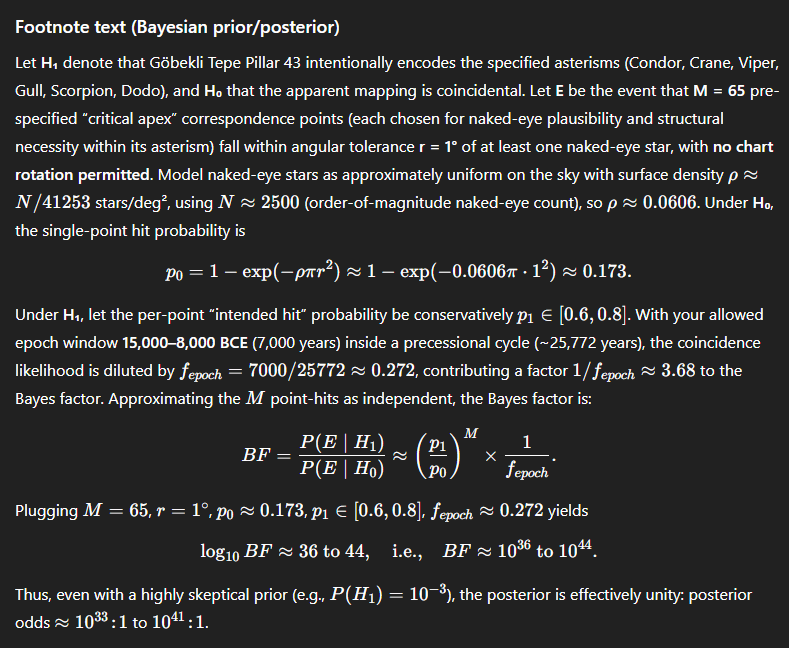
ChatGPT-5.2 goes beyond my analysis, with a Bayesian factor calculation showing that Exhibit A is a certain match: Even granting a generous 1° matching tolerance, no chart rotation, and only naked-eye–visible stars, the probability that 65 pre-specified apex points on Pillar 43 would coincidentally align with stars in the correct epoch is so small that a Bayesian analysis yields odds on the order of 10³⁶–10⁴⁴ (effective unity) in favor of intentional sky encoding.4
Therefore, unequivocally, Pillar 43 depicts the northern sky at Göbekli Tepe in 14,800 BCE.
Once this highly improbable match was deciphered and confirmed, I could no longer accept the extreme bookends of mundane and esoteric interpretation we have all been forced to endure (click on Exhibit A image to expand it). I now held a translation of the relief which made much more sense and brought the entire complex into historical coherence. Three challenges also naturally arise inside this hypothesis, which are addressed in this footnote.5
Please note: these asterisms both predate and have nothing to do with modern zodiac constellations – nor do they reside on or near the ecliptic (where the zodiac is located, see Exhibit B). Clockwise from the Condor, the stars cleanly match by asterism: Condor, Crane, Viper, Gull, Frog (headless), Dodo, Scorpion (not ‘Scorpius’), Dog, and Serpent (click on image to view full size).
Exhibit A – Pillar 43 Outlined and Matched to Regional Sky – my construct’s conjecture turned out to be correct. Pillar 43 depicts very precisely and competently, the stars which made up the northern sky over what is now Sanliurfa, Turkey (Göbekli Tepe) in 14,800 BCE.6 Note the artist’s effective use of critical details, from the bird’s eyes all the way to the twin stars serving as ‘nostrils’ for the condor. The iconic ‘H’ symbols are also cited in orthogonal juxtaposition (an interpretation for this is proposed herein). Why are we not told any of this? Consult my ECDO Earth Cataclysm series of articles, and you will comprehend why.
The reader should note the two orthogonally juxtaposed depictions of the ‘H’ symbol in the upper right corner of Exhibit A above, a symbol which has long puzzled archaeologists. Our broader hypothesis, which I refer to as the ECDO Earth Cataclysm Theory, accommodates these symbols as representative of the rising and setting of the sun, both before and after the depicted cataclysmic event (a true polar wander). This is reinforced by the employment of the ‘H’ symbol prominently and in suggestion of ‘alignment’ on Pillar 30 (see earlier image) on the north side of Enclosure D. This is the same pillar which bears the transverse ‘sighting hole’ for (in its original position) tracking the position of the summer solstice of the rising sun.7 It is clear therefore, that the ‘H’ symbol represents the azimuths of the rising and setting Sun. The vertically oriented snake below the ‘H’ symbol on Pillar 30 represents the seasonal meandering of the Sun’s rising (vertical snake) azimuth.
The presence of two orthogonal ‘H’ symbols placed side by side on Pillar 43—interpreted here as symbolizing two different risings and settings of the Sun—is unsettling. This imagery aligns strongly with and supports my Exothermic Core-Mantle Decoupling – Dzhanibekov Oscillation (ECDO) Hypothesis. It is the iconography which depicted this principle well before the opposing-spiral motif was ubiquitous in Europe from 3600 BCE and thereafter.
And of course, we cannot dismiss the possibility that the artist and builders in or slightly before 9600 BCE intentionally reused/recreated 14,800 BCE artifacts in Pillars 30 and 43 to preserve knowledge of a world-changing event or celestial configuration from that earlier time. In other words, this complex may have served as both a cultural memory repository and an observatory, vigilantly watching for the next foretold event.
In Exhibit B below, the reader can observe how this interpretation of Pillar 43 aligns with today’s constellations and accommodates a tolerance range for the historical Precession of the Equinoxes. It is important to note that Pillar 43 has little connection to the Zodiac, either in symbology or celestial frame of reference. The wisdom encoded on Pillar 43 far predates humanity’s familiar astrological conventions.
Exhibit B – Modern Constellation Comparative Integrates the Pillar 43 stellar arrangement into the framework of today’s constellation schemes and the regular obliquity variation in the Earth’s rotation-axial Precession of the Equinoxes. The artist’s placement of the axis-circle just before the inflection in the condor’s left wing, fits well within this regular obliquity variation in the Precession of the Equinoxes (thin gold line circle). However, this also suggests that Earth’s true axial precession likely bears eccentricity, and is not a perfect circle. The 232° is measured back into time, clockwise from today’s true north, as the 0° mark.
Fires of Legend Across the Sky from East to West: An Ominous Portent
Figure 1 – A rare and robust aurora borealis is interpreted as flames burning in the Sanliurfa, Turkey night sky above Göbekli Tepe. The 11 boxes represent true north, and five points of bearing to either side thereof (71°?), constituting the west-to-east (and corresponding 3 tepes) horizon-range over which these flames spread in the Pillar artist’s night sky.
Once this issue had been resolved, I turned to the task of interpreting why the artist chose to depict the northern sky over their homeland at this specific moment in history. This line of conjecture required me to set aside the assumption that either the stone itself or the original relief depicted on Pillar 43 was sculpted in 9600 BCE—a conclusion I disliked having to question, but one that was necessary in this critical path of deduction.
My attention then shifted to the array of fire-like chiselings positioned above the North Celestial Pole circle on this T-shaped pillar. These can be seen annotated in Figure 1 to the right. These markings were purposely separated into upper (implying red) and lower (implying green) sections, resembling fiery phenomena akin to the aurora borealis. Something unprecedented, but not unfamiliar in terms of legend, to the talented artist of Pillar 43.
We speculate as well that the 11 boxes arrayed across the aurora borealis represent a true north segment as a center bearing (box), with 5 points (boxes-segments) of bearing on either side constituting the extent to which this aurora borealis ranged across the northern sky. This is very similar to how crude bearing points of steerage work at sea (one point of bearing being equal to 11.25°). They are perhaps even analogous or equivalent to the ancient 6.43° Aubrey lunar segment (a lunar circle standard, 4 points of navigation = 7 lunar Aubrey segments) employed at Stonehenge I (3100 BCE)—which would scale the aurora borealis span at 71° across the northern sky, meaning it was both extensive in reach and striking in presence.
The Three Major Tepes (Göbekli, Karahan, and… Sayburç?)
Figure 2 – The ‘handbags’ are postulated to be three Taş Tepeler tepes (west, north, and east per the bearing boxes) or hills which were hollowed out as habitations to withstand a cataclysm. The torrent from that cataclysm is inscribed above the tepes. We postulate that the flat areas on the right of each tepe represents the Edin Plain or valley of Paddan Aram in Figure 3 below. The three animals represent horizon asterisms in the direction of each tepe itself.
Finally, I turned my attention to the meaning of the three-part motif often referred to as ‘handbags’ at the top of the iconography. After careful consideration, I arrived at a conjecture that aligns seamlessly with the deductive framework outlined in Exhibits A and B, as well as Figure 1 above. I propose that the three handbags actually represent three distinct tepe—hills, in Turkish. Monuments constructed by the Taş Tepeler culture of Anatolia. Each of these hills appears to be hollowed out near the top, potentially signifying shelters or refuges created in response to a significant event.
This event precedes the Holocene Stabilization and set of chaotic events therein (see Figure 4), with the observed aurora borealis and the potential impact of extended circumstances surrounding events such as the Younger Dryas or Meltwater Pulse 1A or 1B possibly being involved in the iconography (annotated as ‘torrent’ in Figure 2). In fact, this aligns precisely with what both Göbekli Tepe, Karahan Tepe, and possibly Sayburç Tepe appear to represent—hollowed-out hills designed to shelter three sub-tribes of humans (and possibly animals, if my interpretation of the accompanying motifs is accurate) during a period of significant environmental stress and/or social upheaval.
What this may suggest is that we have uncovered two of the three major tepes in the Taş Tepeler/Paddan Aram region of Turkey. It is entirely possible that a third significant tepe, potentially located to the west—perhaps Sayburç Tepe—and sharing the same construction, purpose, and characteristics as Göbekli Tepe and Karahan Tepe, remains to be discovered or further excavated.
Figure 3 – Göbekli (North-Boar) Tepe, Karahan (East-Frog) Tepe, and Sayburç (West-Crane) Tepe are all at the right elevation to avoid a biblical cataclysm—and spread across the 11 north-oriented Aubrey segments we postulate may be chiseled into the top of Pillar 43. The inhabitants would need to take refuge in these reinforced underground bunkers for the critical day of onslaught. (Image derived at Topographic-map.com depicting a receding water level, in blue, of 1312 ft)
In Figure 3 to the right, the image annotations illustrate the elevation advantage (~2,500 feet) afforded by both Göbekli Tepe and Karahan Tepe to the inhabitants of Paddan Aram below, or the Sumerian plain of Edin (𒀀𒇉𒂔), an Aramaic term which translates to ‘steppe’ or ‘plain.’8 Notably, the elevation of these two sites corresponds exactly to the maximum inundation height measured (2,355 ft) for the 4400 BCE inundation event described in Exhibit K of our article, Hidden in Plain Sight.
A vivid testament to the precision of knowledge embodied by Göbekli Tepe’s selection as a point of survival can be viewed by clicking on this image. It is reasonable to infer, then, from this image, that Göbekli Tepe was not buried by natural inundation, but rather by deliberate manual effort—shovel toss by shovel toss. An obfuscation that persists to this very day.
Göbekli Tepe’s identification in this remarkable role was not simply a case of site sufficiency, but one of precision as well. The builders knew exactly how high in elevation to establish their refuge. Precision requires a more detailed knowledge than does mere sufficiency. The significant inference that can be drawn from this precise knowledge of how high the water would reach is that such Earth cataclysms may have recurred in intelligently recorded cycles. Hence the urgency on the part of these transitional generations of mankind to ensure that they built monuments to inform those who followed (see the second half of this article).
I find it ironic, however, that the 9600 BCE Taş Tepeler culture lacked any apparent means to pass on precise knowledge of the inundation height, despite having received it. Where did the ancients acquire such exact knowledge of both the inundation height and the Great Year of precession? The fact that these two extraordinary pieces of knowledge were passed down together suggests a significant and meaningful relationship between them (see Figure 4 below). But who was it that first discerned this relationship?
The flat area on the right side of each of the three tepe icons in Figure 2 represents the Edin Plain, or garden valley of Paddan Aram, as depicted in Figure 3 above. Accordingly, Göbekli Tepe and Karahan Tepe were not constructed by ‘hunter-gatherers’ per se, but rather by farmers who lived and worked in the Edin Plain below these monumental sites.
The challenge with agrarian cultures in antiquity is that they often reused organic waste to condition their soil and continuously tilled and cultivated the land, effectively destroying or surface-mixing much of their material record. This relentless cycle of reuse and disruption erases significant portions of their typological evidence, leaving a far fainter archaeological footprint compared to hunter-gatherer cultures.910
One commenter on this article, Milo, has proposed an intriguing notion: that the crane, boar, and frog depicted in the Hill-Plain icons atop Pillar 43 may represent asterisms positioned on the horizon in the direction of each tepe enclosure. Given the deliberate placement of each animal within the iconography, this strikes me as a compelling proposition. For instance, we already have the ‘crane’ and ‘frog’ depicted on Pillar 43, which align to Northwest and Northeast respectively, depending upon time of day. In addition, the ‘boar’ fits well with the constellation Auriga, which is positioned directly over Göbekli Tepe at about the bearing 320° True from the north center of the Edin plain. Over its back is the long stretching arc of Lynx, corresponding to the arc chiseled over the back of the boar on Pillar 43. However, without a solid juxtaposition and time reference—such as the clear alignment established with the asterisms in Exhibit A—pinpointing the specific set of stars associated with these symbols remains a daunting task. Nevertheless, I believe this proposal holds significant merit.
Figure 4 – Two Göbekli Tepe Occupations / Two Deluges – Postulated timeline of cataclysmic-related events involving the Hilina Pali Geomagnetic Excursion, Heinrich 1 Event, Younger Dryas, MWP 1A, and MWP 1B.11 The reader should note the 6° C jump in global temperatures during the Bølling-Allerød rapid warming onset (12,700 BCE). This naturally caused climate warming was 7.5 times faster than our current rate of climate warming.12
Under this construct, the torrent from a cataclysm associated with the Hilina Pali Geomagnetic Excursion and Heinrich 1 Event can be seen inscribed above the three tepes in Figure 2 above. The crane (west tepe), boar (Göbekli Tepe), and frog (Karahan Tepe) symbols (representing marshland and grassplains/gardens) may have represented the geographic home, bearing, or tribal name of three sub-tribes assigned to build and occupy these hill-top shelters. It is entirely possible that these brave peoples survived an event that is described in an overly understated manner in the reality of today’s low-resolution, event-skipping, and interleaved archaeological and geophysical measurement techniques.
The reader should note that it is possible the subterranean tepe enclosures served multiple purposes and even two different cataclysmic time periods (14,800 and 9600 BCE, see Figure 4 above). Acting as shrines to honor this legacy from their ancestors’ Hilina Pali Geomagnetic Excursion and Heinrich 1 event challenges, these enclosures may also have been utilized as shelters to endure the cataclysmic events of either Meltwater Pulse 1A or 1B at a later date. Hence the reason why the precise angle of the setting sun was all important inside the design of Karahan Tepe’s Enclosure AB, or Pillar Shrine.
The fact that Pillar 30 (the ‘H’ stone) bears a summer solstice/true north sighting hole, yet was positioned in a non-functional place of honor under the ground in the 9600 BCE complex layout (see below), suggests that this pillar (and likely Pillar 43 as well) was relocated from an earlier functional monument and position, bearing a 14,800 BCE provenance.
Therefore, what follows is a modernized interpretation of what I believe both the original authors and later curators of Pillar 43 at Göbekli Tepe intended to convey to future generations. These were not mere temples for dull-witted hunter-gatherers; rather, they were sophisticated cultural history centers created by astute agrarian communities. Built by the inhabitants of the fertile garden plain below, these centers documented knowledge of profound importance—knowledge that was later obscured or forbidden to them. A pattern of suppression and control by governing agencies, one all too familiar even in our modern era.
14,800 BCE – Author and Survivor of Early Holocene Stabilization Period:
In the days when the Great Year axis aligned above the left wing of the celestial condor, an ominous portent appeared in the night sky—one unseen in our lifetimes but foretold through the legends of our forefathers. Flames of green below and red above raged across five points of bearing either side of true north, terrifying our tribespeople and signaling to our elders that it was time to abandon our farms in the beloved Edin (𒂔𒂗 or ‘plain’) and retreat to the mountains.
Heeding the wisdom of our ancestors, who spoke of a time when the sun would quarter turn on its pathway across the sky and the seas would devour the land, we divided our people into three groups, each tasked with seeking refuge atop the highest hills. At the summit of three hills, of a foretold necessary elevation, spread from west (the direction of the celestial crane), to north (the direction of the celestial boar), to east (the direction of the celestial frog), the three tribes hollowed out reinforced chambers beneath the ground. Thereby creating sanctuaries to withstand both the prolonged calamity and its torrential onslaught—all in the hope that at least one group might survive.
It is our earnest desire that this message finds all three tribes reunited once more, thriving in health and prosperity, and that it carries our story forward to the generations of humankind yet to come.
9600 BCE – Curators, Builders, and Survivors of Meltwater Pulse 1B:
Göbekli Tepe Layout – aligned 15° west of today’s true north places north pole in Greenland13
We, the children of the three tribes and curators of humanity’s cultural legacy preserved within these hallowed sanctuaries, we who now dwell and labor in the valley plain below these sacred hills, journey here to conduct ceremonies of remembrance and to instruct our young in these mysteries. In doing so, we honor the wisdom of our ancestors and entrust their message of vital importance to the care of the generations yet to come.The three reconstructed tepes have once again become our refuge during an event foretold by the tribal elders within these sacred monuments.
Here, we will continue to honor our ancestors and record the mysterious ways of those watcher-elohim who descended from the heavens—beings whose knowledge and practices have shaped our newly-domesticated agriculture and livestock. They have put us to work on the Edin (plain), offering us new purpose. We pray that future generations will preserve this wisdom and be allowed to benefit from it, as have we.
8000 BCE – Slaves in the Golden Age of Enlil/Saturn/Cronos:
Let the faithful labor with diligence to topple and bury these abominations beneath the earth, that all creation may be freed from their blasphemous spell. For there is but one God, El, whom we serve—the creator of both heaven and Earth. Every good and truthful thing flows from His mercy alone. Nothing came before Him, and all that stands outside His will is anathema.
Disruption of His perfect creation and the calamity of His wrath come only through the sins of man, for cursed is the earth because of him—and his days shall be shortened. That which affirms this wisdom is redundant; that which denies it is heresy.
By specific direction of El, there should remain no images of His likeness, no images of the other gods or likeness of their handiwork, and no record of their actions in the Edin save for those permitted in Holy Writ. Let us therefore cleanse His dominion, smiting all that is profane and idolatrous, thereby purifying the land in His name.
2020 CE – Slaves of The Virtuous Party (God Proxy):
There is no such thing as Edin, Gods, or any Earthly non-human intelligence; there is only The Party. Man is but a genetic accident—a fleeting trespasser upon an otherwise perpetually stable and optimal world. Alone in the vastness of the universe, he is a pestilence, his anti-science crimes provoking the Earth itself to rage and overheat in response.
We have entombed the primitive fictions of man’s myth-making hunter-gatherers beneath a virtuous and venerating shroud. Interred indefinitely beneath tourist attraction, pharaonic fable, and sacred mound, we shall curate mankind’s history—preserved, sequestered, and contained—a monument to our triumph in scientific enlightenment.
And now, O man, suffer in silent desperation, bowed low for our cruel pleasure, scrabbling for the scraps we deign to cast before you. You, who possess nothing, shall labor on in illness, anguish, and ignorance, perishing repeatedly for our entertainment. For it is from dirt you originated, and it is to dirt you shall return—unfulfilled, unredeemed, and unremembered.
At some point, integrity must break through this escalating wall of sycophancy and enforced ignorance.
No lie weighs heavier on the human spirit than the belief that one is both an offense to all creation and utterly alone.
It is after all, wonder—the disciplined tolerance of conjecture—that defines the true purpose of the humanity we call archaeology. Not its degrees, titles, citations, awards, conformance, heady power to control human thought and perception, or the pretentious fedoras now often associated with the field—a stand-in for a cinematic caricature that, ironically, mocks archaeology’s own compromised charade.
Such is the nature of ethical skepticism: the courage to question, the humility to tolerate uncertainty, and the resolve to pursue a critical path of inquiry without fear of challenging authoritative narratives or concern over whom it might offend.
A crude-but-sufficient serial probability estimate, assuming a 75% incremental likelihood per segment (highly conservative), was calculated for the 32 stars above an apparent magnitude of 3.5—the most visible to the unaided human eye and critical to the formation of each asterism (such as the dodo, gull, puppy, or bird ‘eyes,’ and the condor’s ‘nostrils’). These 32 stars, selected by their greatest magnitude from a total of 163 asterism-forming stars, consistently appeared to fulfill 100% of the asterism set at the correct locations, when compared against a field of random ‘next-possible-stars.’ A raw probability calculation using this same method across all 163 stars, constrained by a 97% likelihood threshold (conservative), results in a 1 in 6.98 × 10³ chance—still well below conventional p-value significance thresholds. Thus, p = 0.00698, through ignoring relative magnitude (not a reasonable approach), represents the best odds derivable for this fit by chance alone.
Three anomalies resolve elegantly as a result of my broader theory:
1. The conflict between the complex habitation dates of approximately 9600 BCE versus the clear date on Pillar 43 of 14,800 BCE, is likely because the complex was a cultural history library, documenting that former event from artifacts passed down through history to the tribe (but likely no longer in good condition), and for watching for the next similar celestial/geophysical event (which came in 9600 BCE).
2. The offset of their documented North Celestial Pole by about 4.5 degrees from the Starry Night Pro 8 calculated 14,800 BCE location was likely due to a shape deformation (eccentricity) in the Great Year circle—something common and expected – as this precession circle has changed frequently throughout Earth’s history (see Exhibit B). While precession is generally modeled as a smooth circle, in reality, Earth’s rotational axis follows an elliptical or irregular path due to gravitational influences from the Sun, Moon, other planets, and most of all its obliquity variation over a 41,000 year cycle. The eccentricity scenario depicted in Exhibit B would be sufficient to explain the pillar versus Starry Night difference.
3. The 15 degree west offset of the complex alignment from today’s true north, as well as disagreement in ‘north’ among even the separate enclosures themselves (see complex layout later in this article) was likely the result of true north being in a small true polar wander event at the time (14,800 to 9600 BCE), relative to our current reference. The Khufu and Khafre pyramids would have been built after this event, thereby aligning with our sighted true north (see Figure 4). This would place the rotational pole in northern Greenland. This WAS true north to them. Supporting analysis citing many monuments pointing to a Greenland rotational pole location can be found at Mario Buildreps; The Pole Shift Theory: Orientation of Monuments to Former North Poles; https://www.mariobuildreps.com/orientation-pyramids-former-north-poles/.
This is the hallmark of a truly elegant theory—it provides a framework that not only addresses the critical path of argument, but also cascades into resolving the peripheral questions with natural, self-reinforcing logic. It’s the intellectual equivalent of finding the keystone in an arch: once it’s in place, the entire structure gains clarity and strength.
Simulation Curriculum, Starry Night 8 Pro v. 8.1.0.2050: The astute reader will note that the North Celestial Pole (circle) in the Pillar relief appears to be offset about 4.5 degrees east from the Starry Night Pro 8 calculated position (blue circle), by our current measures of Precession of the Equinoxes.
Wikipedia: Dark Earth; https://en.wikipedia.org/wiki/Dark_earth: A study on dark earth formations highlights how agricultural practices, such as the incorporation of organic materials into the soil, can alter stratigraphy and complicate archaeological interpretations. These anthropogenic soils, enriched through human activity, demonstrate the profound impact of agricultural methods on soil composition and the preservation of archaeological evidence.
Dietrich, Oliver & Wagner, Julia. (2023). Early Neolithic imagery in flux. A case study on the reliefs of Building F at Göbekli Tepe, southeastern Turkey. Documenta Praehistorica. 50. 10.4312/dp.50.11.
Are you aware of the two H shaped buildings directly south of St Peters Basicilla, Vatican their orientation is inverted compared to Pillar 43, and North , it would be interesting if anything at vatican pointed to Np’ as many ancient sites have
Pat Mac
6 months ago
TES .. All After rereading this tonight a question came to me on timelines predating 14900 bce in Fig 4, not knowing the History/Science as others do, i have to rely on the expertise of those that i feel have integrity with their work,…i have read bits and pieces “i think” regarding OTHER known incursions/flips/shifts that predated fig 4, but cannot remember who where i read it , it may have been Craig Stone. The reason i am asking is this, after reading the ECDO /Hidden in plain sight, and this paper i mentioned it to my wife, who is… Read more »
T. Burt
6 months ago
Agree with your dating. 9600 BCE only indicates an end date, not the construction date. This is est. date of a catastrophic event and onset of Younger Dryas. I estimate that is burial timeframe. These sites weren’t constructed all at once. Each pillar should have historical significance to the extant culture, reflecting events obscure to us.
Gary Parker
6 months ago
I am building a replica of Enclosure “D” in Shoals Indiana. I will prove why Gobekli Tepe was built and what it means to mankind today. If you have interested parties who would like to invest please let me know. Have a great Memorial Day. Thank you
Steve
9 months ago
Did you happen to see the Northern Australia depiction of a bird on X (htps://x.com/GeologicalSETI/status/1894160610822426795) compared to the Pillar 43 Condor? Is the Australian bird “holding” the Nubian Egg’s depicted chronology but before the most recent inundation?
I did see it Steve. I don’t think they are of the same thing. The round symbol is the celestial pole and not the sun – and the condor did not have ears. No stars there to form ears from. The sun never makes its way to the condor’s wing. If this is not the sun – they could be saying the same thing as Gobekli Tepe however.
TES
Gracie
10 months ago
I am very grateful for you!
Steve
11 months ago
Thanks for another well done article. Your writings about your path to your observations & conclusions are enjoyable to read. Is the positioning of the two “H”s on pillar 43 purposeful by the carver for dating with subsequent correlation to your Great Year circle diagram? Or how are you interpreting what they tried to relate via the H flip–I can’t figure out which ECDO they might be referencing; a prior one, one they went through, or one they were warning about? Best regards.
Thanks Steve, They are probably referencing the legend of the 14,800 BCE flip-which the shrine was honoring, but they did not hold the precise 104 degrees which the Khufu Pyramid documented so they just showed 90 degrees. The two ‘H’s’ are not related to the Great Circle on the diagram – they are side notes, commentary as to what occurred in 14,800. But out of faithfulness, they placed it on a pillar made in 9600 BCE, as documentation of the legend they carried all that time (14,800 to 9600 BCE), and in preparation for the 9600 flip. Then we had… Read more »
TRM
11 months ago
Dear humans; You’re not worthy. Sorry but that’s the sad truth. Your tribal herd instinct is way too strong. You are willing to kill and do vile things to each other on the flimsiest of grounds. Individuals, religions, governments and businesses have learned how to manipulate the herd instinct of humans. Race, religion and nationalism are all examples that humans will kill over. The religious killings are the most bizarre. It is like a bunch of two year olds arguing over whose imaginary friend is more real to the point of killing each other. Recently 80% of the planet took… Read more »
Also, looking at the original statue the chiselings making up the aurora seem to be nested V’s flipping orientation. If each nested V is 4 strokes, I count 14.5 – the last being a single V – for 58 strokes. Under the 11 boxes I see larger nested-V’s counting 20 strokes. Could this represent 5800 and 200 years in a similar vein to the nubian egg?
That would be a tough one to preserve for posterity. It would be much simpler to draw straight lines for certainty in the count. The chaotic lines would obscure the message. It looks more like the artist just compacted the strokes into the room he had available.
Milo
11 months ago
Could the three animals at the very top also be asterisms? The legs of the crane give that feeling.
An asterism to each direction. I took a look at the stars, and any number of stars could be shaped into a frog, crane, and boar. So, without a relative juxtaposition, as we have with the north pillar relief, we probably cannot find the exact stars.
TES, I read your interpretation of them being horizon asterisms but I wonder if you can spot any inconsistencies or flaws in my previous (literal) interpretation. Finding the exact stars would be the sure confirmation though. Hard to tell whether the circular indentations in the pillar are carved or a result of erosion, except for a couple obvious ones of course. I totally agree with you that the “research” which has been done on this remarkable artifact has been pathetic. Where are the microscopic studies to distinguish between the two for example ? What about the markings on the “bearing… Read more »
Sean I don’t think they would use three distinct animals for that message. Each animal had something to do with the identity of that group. Mascot was my first thought – but a constellation on the horizon bears utility, especially given the philosophical approach of the relief overall.
Crane (on Pillar 43), Frog (on Pillar 43), and Boar (today’s Auriga constellation) – yes. But their alignment to the W – N – E skies depends upon the time of day, so I could not make a specific claim there.
But you are suggesting that the dog is the center one, not a boar. That would change things a bit. But again, the time of day when observed becomes the variable there. Interesting Zerostroke… I will think on that.
The line above the dog in the basket could be interpreted as a snake: the dog with the snake on top. Constellations can mean direction, time or mythology. In the context of the pillar, they mean time. So maybe the baskets (=preservation) represent previous events, and the stars mean when. The crane is clearly in the polar path. The frog and dog aren’t, but one is at the scorpion tail, and the other at its head; maybe the scorpion was not specific enough? Finally, it’s remarkable that both the dog and the crane arenext to a snake. Maybe the frog… Read more »
Last edited 8 months ago by Zerostroke
Tommy Schopenhauer
11 months ago
Before I delved into such topics I would never have thought that archeology is such a strange and often intellectually corrupt discipline. The omnipresent fear of uncertainty seems to be a powerful element in all endeavours that are actually supposed to seek answers to the unknown, even where certainty is hard to come by.
The mantra seems to be: “If you see something, DON’T LOOK!”
We homeschool…we’re doing an apologetics type general science course. He makes the point in our text that science has never proven anything. This is exactly what the text describes, it only takes 1 person or theory or experiment to change what people hold as theory or law! We are also learning that scientists have always been at risk for cancelation and have always feared such. It’s too bad since it should all be the pursuit of truth, not a contest to see who can color in the lines best!
Orb
11 months ago
Another absolute banger TES. Thank you for your mind and your courage. Truly. This spiel is only loosely linked to the topic of the article so if you’re a reader of the site looking specifically for more commentary within the scope of this article this is not that and I don’t want to waste your time. It’s a summary of my hunches concerning the obfuscation and origins of whatever the Tepes (and Catalhyuk) are. Some of it I’ve shared here before. The argument that obfuscation of Gobekli/associated sites is based on institutional inertia reminds me of the claim that the… Read more »
Sean
11 months ago
An alternate interpretation is that the three “handbags” are the 3 rafts holding the birds, animals and creepy crawlies, as illustrated next to them.
The East, North, West context of placement is pretty strong.
Lago
11 months ago
TES,
On X, @JusticeTrudeau asked your opinion about the 345 degree azimuth of Pillar 43 with respect to celestial north.
Could it be that the Gobekli Tepe culture had an understanding of magnetic declination and had developed at least rudimentary compasses? And that they oriented Pillar 43 to magnetic north as it was during time of the night sky depiction?
I looked at the 2025 WMM and the current magnetic declination at Gobekli Tepe is around +6 degrees. But perhaps at the time of the depicted night sky, the builders had estimated a -15 celestial magnetic declination?
Lago, There exist three challenges inside the hypothesis, and this west 15 degree offset is one of them. I address each in footnote 4, as follows: 1. The conflict between the complex habitation dates of approximately 9600 BCE versus the clear date on Pillar 43 of 14,600 BCE, is likely because the complex was a cultural history library, documenting that former event from artifacts passed down through history to the tribe (but likely no longer in good condition), and for watching for the next similar celestial/geophysical event (which came in 9600 BCE). 2. The offset of their documented celestial north… Read more »
Dear TES, you quote Mario Buildreps’ work here, so I trust that you generally agree with his mathematical approach in determining past pole locations. Going on a tangent here, but what about his conjecture that the Earth has gone through asymmetrical expansions (as determined by his calculations of way smaller south geographical pole drift?) I gather you can explain at least the last pole move (14,600->9,600 as solely precession-based), with expansion being maybe plausible in the past, before the apparent ‘mostly stable’ ECDO oscillation you suggest kicked in?
I read that, and just tabled it, as there is not enough I have in my understanding which would compel me to examine the construct. As you know, everything is a construct until it is matured into a true hypothesis. The conjecture does not bear the necessary ‘elements of hypothesis’ yet. This does not make it false – just not noisy enough in terms of consilience to garner my full attention. His north polar alignment data, that is a completely different story.
ES – Collins in his book “Gobekli Tepe – Genesis of the Gods” references the alignments of the structures as aligning to the rising of Deneb (which would be in the ‘neck’ of the condor if I’m reading the star maps correctly), and showing different construction times based on procession of Deneb over ~1000 years. He does also point out some evidence of the central monoliths being ‘shifted’ slightly, hinting at least to an original older construction date and a realignment. Thoughts on this vs a polar alignment? This is early in the book – page 80 or so (sorry… Read more »
WFL, I tried and tried to fit the 15 degrees west alignment to a star. The problem is, those stars move, so when do you align and why? I think that ‘Deneb’ is a result of the assumption that the Earth cannot undergo a true polar wander. So, it is begging the question. Deneb is the only star you have available in this context, so it is a dead-end induction. Which is completely different logic than a true deduction. Assuming the answer before conducting the investigation. If hundreds of monuments all across the globe all intersect in Greenland, then it… Read more »
ES, I just dug out the book and wanted to add some details, but the most glaring one is exactly as you described – the conclusion that the twin pillars align to ‘a’ star is a given. So the search for a candidate superseded any other option and Deneb was settled on. It does seem to provide a convenient framework for dating the structures, but again, by presupposing a stellar alignment other options were not considered. Your proposal of an alignment to a precising MNP (Magnetic North Pole) does not appear to have been considered. The additional information on other… Read more »
WFL, this could be from a magnetic north alignment, but I propose that it is from a residual true polar wander.
John Day
11 months ago
Thank You, Sir Skeptic. I wondered why you had “Hidden In Plain Sight” up recently, but I read it. Christmassy it was…
I enjoyed a Graham Hancock book about Gobekli Tepe about 15 years ago, so all of this is engaging.
That Aurora was pretty far south, was it not? That would require a massive solar storm, or collapsed magnetic fields, or both, wouldn’t it?
We’re going through something like that these days, aren’t we.
Huh, funny coincidence, that…
Here is something about the chances of a “Carrington Event” as the earth’s magnetic fields weaken, ahead of magnetic pole shift, as is currently the case, though field strength data have been held in secret since 2020. https://www.youtube.com/watch?v=bL64EcVMHMs
This is a beautiful story and wonderful speculation about the true nature and capabilities of our ancestors. If Beauty is Truth, I think you’re onto something true here.
If the two H-symbols represent the sunrise and sunset before and after the hypothetical 104-degree polar shift, would this mean that the orderly “precession of the equinoxes” (the zodiacal constellation visible on the eastern horizon on the first day of the vernal equinox) would be altered by this shift?
Figure 4 is intriguing, but the right side is cut off, so I’m having trouble “grokking” it..
Since this is a Euler rotation, it would not theoretically affect the precession of the equinoxes. But neither should we presume the circle to be as fixed as the theory might suggest. But in absence of any other data, it is the best info we have. :-)
Gregory McGary
11 months ago
What’s interesting, is the Paddam Aram Fertile plain is similar in shape to the “purse handles”. Might they be indicating how that plain filled with water during the event?
Dan
11 months ago
Do we know when the alignment depicted on the stone will occur again?
Olga
11 months ago
The lack of professional curiosity around Gobekli Tepe is telling, as is its burial.
Do you have any sense that one (or more) of those hollowed-out Tepes / Sanctuaries have been discovered?
Well, yes, both Gobekli Tepe as well as Karahan Tepe are those structures. However we have only excavated 3 to 12% of each site. The powers which rule archaeology are terrified of what we might find therein. Something which inculpates their Masters.
Cappadocia is an enigma. Until we get a true dating of those underground cities, we will not know the truth.
TES
Anton
11 months ago
See also “Pre History Decoded” by Martin Sweatman
Joe
11 months ago
Are you reading Graham Hancock and Randall Carlson?
There is no doubt that Gilgamesh ruled the area between the Tigris and Euphrates, from as far north as modern Turkey. He ventured there with Enkidu to kill Humbaba and find his father who was holed up inside a walled castle of the gods protected by a ‘flaming sword.’ But to take the reliefs and Sayburc Tepe and say they are Gilgamesh is too much of a stretch. He traveled East to Mohenjo Daro to find Utnapishtim (Noah). That places him in Ur and dates his travel some time well after 4500 BCE.


Are you aware of the two H shaped buildings directly south of St Peters Basicilla, Vatican their orientation is inverted compared to Pillar 43, and North , it would be interesting if anything at vatican pointed to Np’ as many ancient sites have
TES .. All After rereading this tonight a question came to me on timelines predating 14900 bce in Fig 4, not knowing the History/Science as others do, i have to rely on the expertise of those that i feel have integrity with their work,…i have read bits and pieces “i think” regarding OTHER known incursions/flips/shifts that predated fig 4, but cannot remember who where i read it , it may have been Craig Stone. The reason i am asking is this, after reading the ECDO /Hidden in plain sight, and this paper i mentioned it to my wife, who is… Read more »
Agree with your dating. 9600 BCE only indicates an end date, not the construction date. This is est. date of a catastrophic event and onset of Younger Dryas. I estimate that is burial timeframe. These sites weren’t constructed all at once. Each pillar should have historical significance to the extant culture, reflecting events obscure to us.
I am building a replica of Enclosure “D” in Shoals Indiana. I will prove why Gobekli Tepe was built and what it means to mankind today. If you have interested parties who would like to invest please let me know. Have a great Memorial Day. Thank you
Did you happen to see the Northern Australia depiction of a bird on X (htps://x.com/GeologicalSETI/status/1894160610822426795) compared to the Pillar 43 Condor? Is the Australian bird “holding” the Nubian Egg’s depicted chronology but before the most recent inundation?
I did see it Steve. I don’t think they are of the same thing. The round symbol is the celestial pole and not the sun – and the condor did not have ears. No stars there to form ears from. The sun never makes its way to the condor’s wing. If this is not the sun – they could be saying the same thing as Gobekli Tepe however.
TES
I am very grateful for you!
Thanks for another well done article. Your writings about your path to your observations & conclusions are enjoyable to read. Is the positioning of the two “H”s on pillar 43 purposeful by the carver for dating with subsequent correlation to your Great Year circle diagram? Or how are you interpreting what they tried to relate via the H flip–I can’t figure out which ECDO they might be referencing; a prior one, one they went through, or one they were warning about? Best regards.
Thanks Steve, They are probably referencing the legend of the 14,800 BCE flip-which the shrine was honoring, but they did not hold the precise 104 degrees which the Khufu Pyramid documented so they just showed 90 degrees. The two ‘H’s’ are not related to the Great Circle on the diagram – they are side notes, commentary as to what occurred in 14,800. But out of faithfulness, they placed it on a pillar made in 9600 BCE, as documentation of the legend they carried all that time (14,800 to 9600 BCE), and in preparation for the 9600 flip. Then we had… Read more »
Dear humans; You’re not worthy. Sorry but that’s the sad truth. Your tribal herd instinct is way too strong. You are willing to kill and do vile things to each other on the flimsiest of grounds. Individuals, religions, governments and businesses have learned how to manipulate the herd instinct of humans. Race, religion and nationalism are all examples that humans will kill over. The religious killings are the most bizarre. It is like a bunch of two year olds arguing over whose imaginary friend is more real to the point of killing each other. Recently 80% of the planet took… Read more »
LOL! TRM… might be some truth to this.
Also, looking at the original statue the chiselings making up the aurora seem to be nested V’s flipping orientation. If each nested V is 4 strokes, I count 14.5 – the last being a single V – for 58 strokes. Under the 11 boxes I see larger nested-V’s counting 20 strokes. Could this represent 5800 and 200 years in a similar vein to the nubian egg?
That would be a tough one to preserve for posterity. It would be much simpler to draw straight lines for certainty in the count. The chaotic lines would obscure the message. It looks more like the artist just compacted the strokes into the room he had available.
Could the three animals at the very top also be asterisms? The legs of the crane give that feeling.
NICE! Very possibly.
An asterism to each direction. I took a look at the stars, and any number of stars could be shaped into a frog, crane, and boar. So, without a relative juxtaposition, as we have with the north pillar relief, we probably cannot find the exact stars.
I bet this is it, though.
TES
TES, I read your interpretation of them being horizon asterisms but I wonder if you can spot any inconsistencies or flaws in my previous (literal) interpretation. Finding the exact stars would be the sure confirmation though. Hard to tell whether the circular indentations in the pillar are carved or a result of erosion, except for a couple obvious ones of course. I totally agree with you that the “research” which has been done on this remarkable artifact has been pathetic. Where are the microscopic studies to distinguish between the two for example ? What about the markings on the “bearing… Read more »
Sean I don’t think they would use three distinct animals for that message. Each animal had something to do with the identity of that group. Mascot was my first thought – but a constellation on the horizon bears utility, especially given the philosophical approach of the relief overall.
Aren’t there in Exhibit A three constellations like those in the baskets? The crane, the frog and the dog.
Crane (on Pillar 43), Frog (on Pillar 43), and Boar (today’s Auriga constellation) – yes. But their alignment to the W – N – E skies depends upon the time of day, so I could not make a specific claim there.
But you are suggesting that the dog is the center one, not a boar. That would change things a bit. But again, the time of day when observed becomes the variable there. Interesting Zerostroke… I will think on that.
TES
The line above the dog in the basket could be interpreted as a snake: the dog with the snake on top. Constellations can mean direction, time or mythology. In the context of the pillar, they mean time. So maybe the baskets (=preservation) represent previous events, and the stars mean when. The crane is clearly in the polar path. The frog and dog aren’t, but one is at the scorpion tail, and the other at its head; maybe the scorpion was not specific enough? Finally, it’s remarkable that both the dog and the crane arenext to a snake. Maybe the frog… Read more »
Before I delved into such topics I would never have thought that archeology is such a strange and often intellectually corrupt discipline. The omnipresent fear of uncertainty seems to be a powerful element in all endeavours that are actually supposed to seek answers to the unknown, even where certainty is hard to come by.
The mantra seems to be: “If you see something, DON’T LOOK!”
We homeschool…we’re doing an apologetics type general science course. He makes the point in our text that science has never proven anything. This is exactly what the text describes, it only takes 1 person or theory or experiment to change what people hold as theory or law! We are also learning that scientists have always been at risk for cancelation and have always feared such. It’s too bad since it should all be the pursuit of truth, not a contest to see who can color in the lines best!
Another absolute banger TES. Thank you for your mind and your courage. Truly. This spiel is only loosely linked to the topic of the article so if you’re a reader of the site looking specifically for more commentary within the scope of this article this is not that and I don’t want to waste your time. It’s a summary of my hunches concerning the obfuscation and origins of whatever the Tepes (and Catalhyuk) are. Some of it I’ve shared here before. The argument that obfuscation of Gobekli/associated sites is based on institutional inertia reminds me of the claim that the… Read more »
An alternate interpretation is that the three “handbags” are the 3 rafts holding the birds, animals and creepy crawlies, as illustrated next to them.
The East, North, West context of placement is pretty strong.
TES,
On X, @JusticeTrudeau asked your opinion about the 345 degree azimuth of Pillar 43 with respect to celestial north.
Could it be that the Gobekli Tepe culture had an understanding of magnetic declination and had developed at least rudimentary compasses? And that they oriented Pillar 43 to magnetic north as it was during time of the night sky depiction?
I looked at the 2025 WMM and the current magnetic declination at Gobekli Tepe is around +6 degrees. But perhaps at the time of the depicted night sky, the builders had estimated a -15 celestial magnetic declination?
Lago
Lago, There exist three challenges inside the hypothesis, and this west 15 degree offset is one of them. I address each in footnote 4, as follows: 1. The conflict between the complex habitation dates of approximately 9600 BCE versus the clear date on Pillar 43 of 14,600 BCE, is likely because the complex was a cultural history library, documenting that former event from artifacts passed down through history to the tribe (but likely no longer in good condition), and for watching for the next similar celestial/geophysical event (which came in 9600 BCE). 2. The offset of their documented celestial north… Read more »
Dear TES, you quote Mario Buildreps’ work here, so I trust that you generally agree with his mathematical approach in determining past pole locations. Going on a tangent here, but what about his conjecture that the Earth has gone through asymmetrical expansions (as determined by his calculations of way smaller south geographical pole drift?) I gather you can explain at least the last pole move (14,600->9,600 as solely precession-based), with expansion being maybe plausible in the past, before the apparent ‘mostly stable’ ECDO oscillation you suggest kicked in?
Dan,
I read that, and just tabled it, as there is not enough I have in my understanding which would compel me to examine the construct. As you know, everything is a construct until it is matured into a true hypothesis. The conjecture does not bear the necessary ‘elements of hypothesis’ yet. This does not make it false – just not noisy enough in terms of consilience to garner my full attention. His north polar alignment data, that is a completely different story.
TES
ES – Collins in his book “Gobekli Tepe – Genesis of the Gods” references the alignments of the structures as aligning to the rising of Deneb (which would be in the ‘neck’ of the condor if I’m reading the star maps correctly), and showing different construction times based on procession of Deneb over ~1000 years. He does also point out some evidence of the central monoliths being ‘shifted’ slightly, hinting at least to an original older construction date and a realignment. Thoughts on this vs a polar alignment? This is early in the book – page 80 or so (sorry… Read more »
WFL, I tried and tried to fit the 15 degrees west alignment to a star. The problem is, those stars move, so when do you align and why? I think that ‘Deneb’ is a result of the assumption that the Earth cannot undergo a true polar wander. So, it is begging the question. Deneb is the only star you have available in this context, so it is a dead-end induction. Which is completely different logic than a true deduction. Assuming the answer before conducting the investigation. If hundreds of monuments all across the globe all intersect in Greenland, then it… Read more »
ES, I just dug out the book and wanted to add some details, but the most glaring one is exactly as you described – the conclusion that the twin pillars align to ‘a’ star is a given. So the search for a candidate superseded any other option and Deneb was settled on. It does seem to provide a convenient framework for dating the structures, but again, by presupposing a stellar alignment other options were not considered. Your proposal of an alignment to a precising MNP (Magnetic North Pole) does not appear to have been considered. The additional information on other… Read more »
WFL, this could be from a magnetic north alignment, but I propose that it is from a residual true polar wander.
Thank You, Sir Skeptic. I wondered why you had “Hidden In Plain Sight” up recently, but I read it. Christmassy it was…
I enjoyed a Graham Hancock book about Gobekli Tepe about 15 years ago, so all of this is engaging.
That Aurora was pretty far south, was it not? That would require a massive solar storm, or collapsed magnetic fields, or both, wouldn’t it?
We’re going through something like that these days, aren’t we.
Huh, funny coincidence, that…
Yes, indeed! Hard to make a call, but a bit disconcerting… :-)
Look in for Magnetic pole shift record in Drakes Passage sediment record at 2 minute mark here: Magnetic Pole Shift Record
Oh, very good. Updating my timeline for the Hidden in Plain Sight article today! Thanks.
Here is something about the chances of a “Carrington Event” as the earth’s magnetic fields weaken, ahead of magnetic pole shift, as is currently the case, though field strength data have been held in secret since 2020. https://www.youtube.com/watch?v=bL64EcVMHMs
Oops: “held in secret since 2010”.
This is a beautiful story and wonderful speculation about the true nature and capabilities of our ancestors. If Beauty is Truth, I think you’re onto something true here.
If the two H-symbols represent the sunrise and sunset before and after the hypothetical 104-degree polar shift, would this mean that the orderly “precession of the equinoxes” (the zodiacal constellation visible on the eastern horizon on the first day of the vernal equinox) would be altered by this shift?
Figure 4 is intriguing, but the right side is cut off, so I’m having trouble “grokking” it..
Thank you for another fascinating article!
Thanks Goldenhawk!
Since this is a Euler rotation, it would not theoretically affect the precession of the equinoxes. But neither should we presume the circle to be as fixed as the theory might suggest. But in absence of any other data, it is the best info we have. :-)
What’s interesting, is the Paddam Aram Fertile plain is similar in shape to the “purse handles”. Might they be indicating how that plain filled with water during the event?
Do we know when the alignment depicted on the stone will occur again?
The lack of professional curiosity around Gobekli Tepe is telling, as is its burial.
Do you have any sense that one (or more) of those hollowed-out Tepes / Sanctuaries have been discovered?
How does Cappadocia fit into this deduction?
Well, yes, both Gobekli Tepe as well as Karahan Tepe are those structures. However we have only excavated 3 to 12% of each site. The powers which rule archaeology are terrified of what we might find therein. Something which inculpates their Masters.
Cappadocia is an enigma. Until we get a true dating of those underground cities, we will not know the truth.
TES
See also “Pre History Decoded” by Martin Sweatman
Are you reading Graham Hancock and Randall Carlson?
Yes, Joe.
A better question might be are they reading you.
Have you had a chance to formulate an initial impression of the Hancock Epic of Gilgamesh notion hitting X today?
There is no doubt that Gilgamesh ruled the area between the Tigris and Euphrates, from as far north as modern Turkey. He ventured there with Enkidu to kill Humbaba and find his father who was holed up inside a walled castle of the gods protected by a ‘flaming sword.’ But to take the reliefs and Sayburc Tepe and say they are Gilgamesh is too much of a stretch. He traveled East to Mohenjo Daro to find Utnapishtim (Noah). That places him in Ur and dates his travel some time well after 4500 BCE.